May 23, 2017

My brother. My Inspiration. Our story.

My younger brother Brandon is 23 years old and is part of the Gigi's Fox Valley Playhouse. His favorite Gigi's programs have included Teen Tastic, Fantastic Friends, and the Dance at Gigi's program. Music and dancing help Brandon come alive, showing off his dance skills in his "moonwalk", break dancing, jumping, and other cool moves! He looks forward to the Dance at Gigi's classes and performances, as music helps transport him to a place where he can be himself, express himself, feel a part of something, and have social interaction opportunities with other dancer participants. #321daysofacceptance, #bestofall #GenerationG, #Gigi'sPlayhouse
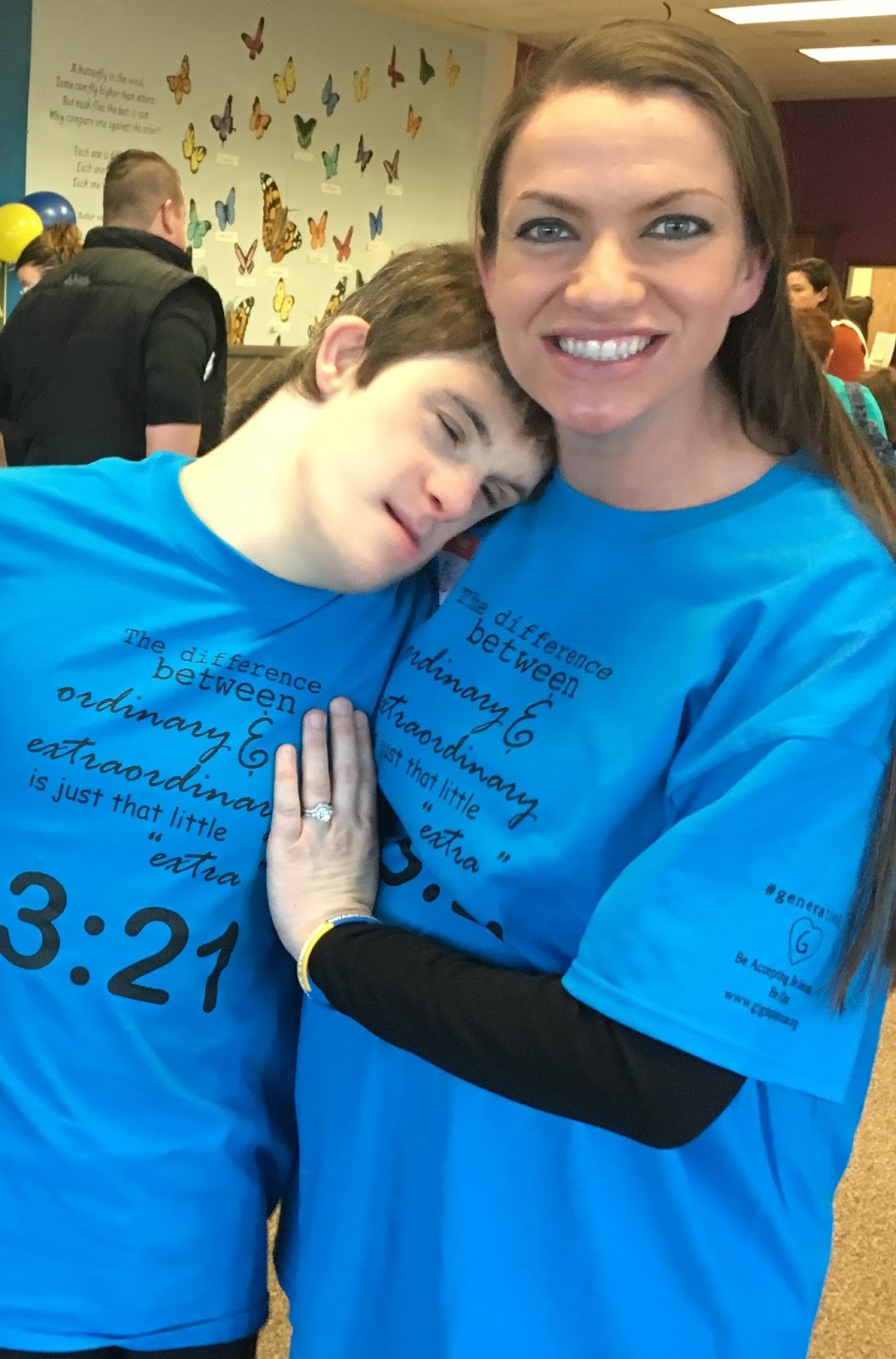
Brandon has a dual diagnosis of Down Syndrome & Autism, along with other conditions which include sensory processing disorder and seizures. Music and dancing has helped Brandon overcome a lot of his challenges to help him be his "best of all"!


My brother Brandon has also inspired me to be my "best of all", to pursue a career in special education for 8 years, and now as an IEP advocate helping families. It had been a rough road for Brandon in his later schooling. He struggled with behavior from the auras of oncoming seizures, something that was unknown at the time. I have learned it is not only important to be your child's best advocate in the school setting, but also within the medical setting. We knew something just wasn't right. (It is important to follow that "mommy intuition" because it is usually always right!). Once it was determined that these behaviors were indeed tied to seizures, doctors were able to find successful medication to control the seizures and low and behold, the behaviors started to greatly decrease! At first, the school had recommended a residential schooling placement. After a bit of advocating with doctors and then with the school, following many 7 hour plus meetings with the school district lawyer, I was able to get my brother Applied Behavior Analysis (ABA) behavioral therapy services both in the school and home settings. This helped Brandon learn important coping skills based on the different functions of behavior, while learning how to communicate his feelings. At the time, ABA was newly recognized by school districts as an effective intervention. Now it is one that is widely used by school districts as part of professional development for staff to implement ABA strategies within the classroom. After much advocacy work on my behalf with his school district, Brandon was able to stay in his current placement at the time by bringing the behavioral services to him, so that he could be successful in his least restrictive environment. I learned a lot about the importance of advocacy and was then inspired to do a career shift from teaching special education, to helping other parents advocate for their child's unique needs in the special education system, via the IEP.  

Gigi's Playhouse has had a profound impact on Brandon throughout the years, as well as myself and the rest of my family. It has given Brandon a social outlet and a place to challenge himself, while providing my parents a place to chat with other families for support. This is an organization very near and dear to my heart! I have been a Gigi's Playhouse volunteer, parent presenter, as well as a group leader for Fantastic Friends for adults with Down Syndrome.

Seeing Brandon's strength and determination to overcome his challenges, as well as those of other participants at Gigi's Playhouse, has been inspirational! It has further inspired me to never give up fighting for these kids and young adults, giving them a voice to get their needs met through effective advocacy.  

For updates on IEP advice and tips, b
e sure to like IEP Consulting, LLC's new Facebook page! Feel free to tag your friends in your online support groups and Special Needs PTA! The more resources in parents' hands to become their "best of all", the better, so keep spreading the word! 

Written by: Carly Quinlan, IEP Consultant & Advocate with IEP Consulting, LLC
IEPconsultingLLC@gmail.com 
SHARE:

May 2, 2017

How & Why to Take Good Notes in Your Child's Next IEP Meeting


Taking notes is a great way to document exactly what was discussed in your child's IEP meeting. In every IEP meeting, you may see more than one person on his or her laptop quickly typing away documenting every detail for the school's copy of meeting notes which will be included in the final paperwork you receive at the end of your meeting. However, not every detail that is important to you will be included in their notes.

To ensure you fully understand your child’s IEP, you may want to take your own notes in the following areas listed below. By the end of the meeting, you should understand exactly how the following areas will be fulfilled for your child. If you are not sure, ask! If you disagree, speak up because you are part of the team and CAN contribute your thoughts and ideas! 

Note taking areas you may want to focus on:
--new goals your child will be working on for each area
--accommodations & modifications
--behavioral supports (if applicable)
--qualify for Extended School Year (ESY)?
--special bus transportation details
--your child's placement
--amount of time spent with typical peers
--the what, when, where, & how of related service minutes (i.e.: for speech, OT, PT, social work, adaptive PE, etc)
--the school's responses to each of your concerns, requests, thoughts and ideas so you can follow up on these later to keep all accountable

Email me for your FREE copy of "A Parent's Note Taking Template for the IEP Meeting" to help keep your note taking on track during the meeting. IEPconsultingLLC@gmail.com 

It is a good idea to cross reference your notes with the final copy of the IEP you receive after the meeting, to ensure all areas of the IEP were updated accurately, as discussed. Sometimes important details and edits don't save accurately in certain IEP programs due to technical glitches, and sometimes there is just so much discussing going on, the school team may forget to update certain things. (I have seen this happen many times.) So if you see any discrepancies, bring it to the IEP team’s attention as soon as possible, to make an amendment to the IEP. 

If you are too overwhelmed in the meeting to take notes or not sure how to make sure all changes were accurately updated in the appropriate areas of your child's new IEP, an IEP consultant/advocate can do this all for you!

If you have a request for an IEP blogging topic you would like to read about, feel free to comment in the comment section below! Also, be sure to like IEP Consulting, LLC's new Facebook page for updates on IEP advice and tips! Feel free to tag your friends in your online support groups! The more resources in parents' hands, the better, so keep spreading the word! 

Written by: Carly Quinlan, IEP Consultant & Advocate with IEP Consulting, LLC
IEPconsultingLLC@gmail.com 
SHARE:

April 24, 2017

How To Organize All That IEP Paperwork


If you have a child with an IEP, you know you will undoubtedly be receiving a TON of paperwork, forms, reports, etc all the time! It can be very confusing as to what each one is and what it all means. Staying organized as you receive each set of paperwork can help alleviate the feeling of being so overwhelmed.

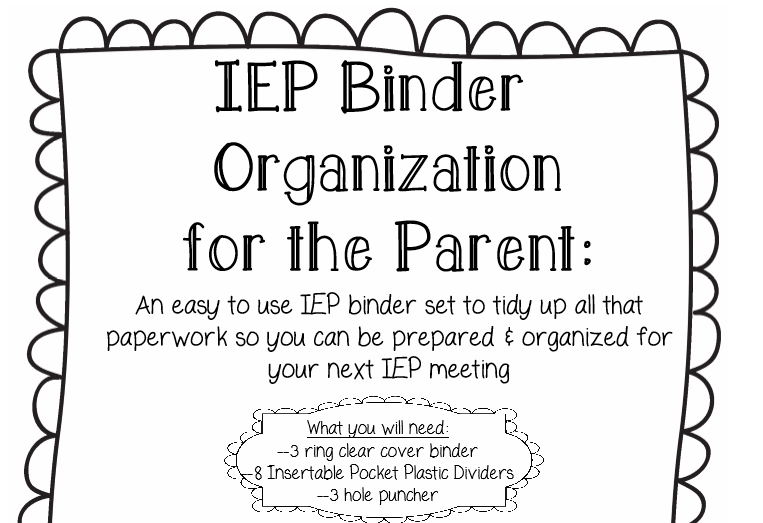
Creating an IEP 3 ring binder with tab dividers and a 3 hole puncher can help you not only look but feel more prepared for your next IEP meeting.

Email me at IEPconsultingLLC@gmail.com for how to order copy of my IEP Binder Organization set! This packet includes divider page covers to organize all the paperwork you receive from your school. My packet also includes helpful handouts such as parent-school communication tools, IEP acronyms and definitions, meeting prep tools for the parent, meeting note taking tools, and more!

Ideas for divider pages for your IEP binder organization or filing system may include:
--Procedural Safeguards (you will receive a copy of this document annually)
--Domain paperwork updated every 3 years or as needed (includes consent for evaluation or re-evaluation, Identification of Needed Assessments, & Evaluation Reports)
--IEP Meeting Invite & Draft of Reports for your upcoming meeting (you should receive a draft copy of updated progress and draft of proposed new goals before your next annual review IEP meeting)
--Finalized current IEP in place (to be replaced after each annual review meeting)
--Meeting Notes (include your own notes as well as the school's notes)
--IEP Amendments if applicable (amendments are edits/changes to the IEP throughout the year)
--Progress Reports on Goals & Report Cards (you may want to tab each goal by related service area using post-its)
--Parent-School Communication (copies of emails and notes from school staff to quickly refer to later if needed)

Once you receive your finalized paperwork after your IEP meeting, you may want to tab the following pages with post-it notes so you can easily refer to each section when needed:
--Present Levels of Performance
--Behavior Plan (if applicable)
--Goals & Objectives/Benchmarks
--Accommodations, Supports, & Modifications
--Services, Minutes, & Placement
--Transportation
--ESY (Extended School Year)
--Transition Plan (starting at age 14 ½)

Store old IEPs in a separate file in chronological order, marked with the dates it was in place. You may want to refer back to it later, even if it is just to see how far your child has come over the years.

You may want to create a separate binder(s) to store/organize student work samples by grade, including tests/quizzes (both good & bad), homework, etc. You can use it to refer to in a meeting and/or to document your child’s growth.

To order printable download of "A Parent's IEP Binder Organization Set", visit:
If you are unsure or too overwhelmed, hand over all your paperwork to me and I can help you sort it out, organize, and make sense of it all as part of my report review service!

To place an order, it is quick, easy, and free to create an account for access to tons of great parent resources on TeachersPayTeachers.com. You don't have to be a teacher to shop! Shop where the teachers shop for printable downloads and resources for your child! 

Also, be sure to like IEP Consulting, LLC's new Facebook page for updates on IEP advice and tips! Feel free to tag your friends in your support groups! The more resources in parents' hands, the better, so keep spreading the word! 
https://www.facebook.com/IEP-Consulting-LLC-1725330307778410

If you have a request for an IEP blogging topic you would like to read about, feel free to comment in the comment section below!

Written by: Carly Quinlan, IEP Consultant & Advocate with IEP Consulting, LLC
IEPconsultingLLC@gmail.com 
SHARE:

April 3, 2017

Behavior Intervention Plans: What You Need To Know!


A Behavior Intervention Plan (BIP) can be part of an Individual Education Plan (IEP) if your child's behavior interferes with his or her learning and/or the learning of others. A BIP is how an IEP addresses the child's negative behaviors called "targeted behaviors". The first step to getting a BIP is a Functional Behavioral Assessment (FBA) with parent's consent. This assessment looks at behavioral data to determine the possible function of the behavior. All behavior is a form of communication.
Functions, or purpose, of behavior may include:
  • to gain attention
  • to escape/avoid something non-preferred
  • to gain access to a preferred tangible
  • to get automatic sensory stimulation (i.e.: hand flapping)
  • a medical cause

A well written and implemented Behavior Intervention Plan (BIP) can make all the difference in a student's success at school. A student can't get to academic learning until behavioral learning is under control. A BIP should include specific behavioral strategies and supports, motivators and rewards for positive reinforcement, and the teaching of replacement behaviors based on the identified function of behavior. There should also be an IEP goal to go with the BIP to monitor progress toward his or her behavior goal. A correct identification of the function of behavior can allow for an effective BIP, as evidenced by the reduced frequency and severity of your child's targeted negative behaviors.

However, an incorrect identification of the function of behavior can actually worsen your child's behavior. Therefore, it is important to closely monitor the effectiveness of the current BIP.

If your child is having behavior issues at school, stay in frequent contact with the social worker, teacher, and school team. If your child is not making progress and/or is regressing with his/her current Behavior Intervention Plan, then this necessitates the team to re-look at the FBA and BIP to determine what changes need to be made to help the child become more successful. Perhaps this may include reconsidering the function of the behavior and/or changing up the motivator & reinforcers to make it more enticing to the student.

Applied Behavior Analysis (ABA) is the scientific study of behavior and learning. This can make all the difference when writing and implementing an effective BIP.

You may want to contact an IEP advocate to help you when:
  • your child's behavior is causing the school team to reconsider your child's placement
  • your child's behavior is getting worse in severity and frequency
  • you disagree with the determined function of behavior, interventions, or any other component of the current BIP
  • your child does not yet have a BIP but continues to have behaviors that interfere with the learning environment
  • the team is not teaching your child appropriate replacement behaviors that serve the same function in a more appropriate way (i.e.: student will slap his desk to replace striking out at others)
  • the school refuses to try a 1:1 aide or outside ABA therapist when behavior continues to worsen
  • your child gets suspended or expelled for behavior that is the result of his or her disability
SHARE:

March 13, 2017

Want to change something in your child's IEP after the meeting?


It happens... You give your signature, leave the IEP meeting, take home your paperwork, and get home only to realize you forgot to request something to be included in your child's IEP. Perhaps they forgot to indicate a certain accommodation or you are still unsure on the placement decided on in the meeting. Not to worry because it is never too late to request an edit to your child's IEP, via an IEP amendment.

You can request an IEP amendment meeting at any time to revise/amend the IEP, as needed. A meeting may not always be required in order to make an edit, depending on the change. You do not need to wait a whole year until your child's next annual review meeting. It is best practice to go to the professional that your concern relates to first. For example, if you see your child has accomplished his or her speech goal prior to the next annual review date, contact the speech therapist to thank and celebrate your child's progress! Then inquire about drafting up a new goal to keep your child moving forward on that skill.  A new goal can be added via an IEP amendment. Or if your child is not making adequate progress on a particular goal, perhaps a goal revision is necessary to make it more achievable. It is case specific if a face to face meeting is needed to make a change to an IEP. 

If there is something you are uncomfortable with about your child's current IEP and you would like something changed and don't know how to go about it, you can contact an IEP consultant to help guide you. This is especially helpful when the school may not be completely willing to comply with your edit request, such as a request for an aide, behavior plan, change in accommodations, change in placement that is not working, etc.

In honor of World Down Syndrome Day on 3/21, IEP Consulting, LLC is offering 50% off services* booked in the month of March! 
*Limited to phone consultation, report review, and letter writing services. 

Also, be sure to like IEP Consulting, LLC's new Facebook page for updates on IEP advice and tips! Feel free to tag your friends in your support groups!

If you have a request for an IEP blogging topic you would like to read about, please comment in the comment section below!

Written by: Carly Quinlan, IEP Consultant & Advocate with IEP Consulting, LLC
IEPconsultingLLC@gmail.com 
SHARE:

February 21, 2017

Springtime Means Transition Meetings Are Around the Corner!


Springtime is almost here! March, April, & May tend to be busy IEP months for schools, especially if your child's annual review of the IEP is due and/or if your child will be attending a new school next year! Perhaps your little preschooler attending the district's Early Childhood program is moving on to Kindergarten next year... Or your elementary schooler is preparing for the bigger world of middle school... Or maybe your child is moving on to high school next year! Springtime is when you will meet with the school team to ensure the IEP is appropriately edited to support your child in that BIG transition, via an IEP transition meeting.*

(*Please note that the transition meeting being referred to here is not to be confused with "transition planning", which is something different that begins at age 14 for post-schooling planning.)

Sometimes your transition meeting for moving on to a new school may be combined with an annual review. In either case, it is important to ask a few clarifying questions to ensure your child is properly supported in the new school environment next year. Typically, a representative from the new school may attend your transition meeting.

One big decision to come out of this meeting is placement determination at the new school. This may differ than your child's current placement. Be sure to ask clarifying questions about this and discuss what supports need to be in place to make a possible placement change successful.

For example, in an Early Childhood program, if your child's current placement is in a blended classroom, this may not be the case for kindergarten. In middle school, your child's time with general education peers may look different than it did in elementary school. Discuss all options with your child's IEP team and how each placement option looks.

The continuum of federally mandated placement options from least to most restrictive that every school district must consider in an IEP meeting is as follows:

1.) General Education
2.) General Education with accommodations
3.) Resource Program (student spends less than 60% of day in Special Education services)
4.) Instructional/Cross Categorical Program (student spends more than 60% of day in Special Education self-contained program)
5.) Public Day Program
6.) Private Day Program
7.) Residential Program


The great thing about IEPs are that they can be completely customizable for that child, no matter what the placement. And the placement can be customized as well, via a combination of any of the above options, as deemed appropriate to your child's unique needs.

Before agreeing to a certain placement, you can request to visit the option(s) in person. (Be sure this gets scheduled before the end of the current school year.) Remember, as a parent, feel free to speak up on your thoughts, as you are indeed a member of the team and a part of this important decision. 

As the first day of school nears in August, be sure to schedule a separate visit for your child to see the school (i.e.: see where the classroom is, meet the teacher, tour the school, see where the bus will come, etc). This will help prepare your child to know what to expect, reducing any first day jitters for both of you!  

Do you have a transition meeting coming up? Feel free to send me an email with specific questions you have, to help you plan ahead prior to your meeting date. I would be happy to have a complimentary 15 minute phone call with you!

Want to learn more about IEPs and advocacy? Gigi's Playhouse Fox Valley will be hosting a "Parents' Night Out" on April 23rd where I will be presenting. Topics to be discussed include how to prepare for your next IEP meeting, how to effectively convey your concerns to the school team, important questions you may want to ask, and more! Each attendee will receive a FREE copy of my IEP Organization Packet to help you organize all that paperwork from the school. RSVP to the Fox Valley Playhouse! Hope to see you there! 
SHARE:

February 13, 2017

Tips for Preparing for Your Child's IEP Meeting


It is important to always keep an open line of communication with your child's IEP team, especially in the weeks leading up to your meeting. Be sure to touch base with your child's teacher and each therapist to discuss areas of strength, concern, progress on goals, and their thoughts for new goals. Be sure to share your thoughts, as you are part of the team!

In this post, I have included a complimentary PDF document of "A Parent's IEP Meeting Prep Sheet".
Click here to access it: A Parent's IEP Meeting Prep Sheet

Below is a list of things this document includes that will help you organize your thoughts on paper ahead of time, so you can easily refer to it in your meeting.

List out...
  • your child's strengths
  • things that are going well this year
  • your biggest areas of concern for your child within the educational setting
  • strategies that work well at home
  • update from any services/therapies your child is receiving outside of school, if applicable
  • reminder for staff of food allergies, medical/health info & concerns, if any
  • any special transportation needs
  • any specific questions you want to remember to ask

Ensure your concerns are documented in the paperwork and meeting notes. If you would like, you can request to have your list of concerns be added to the IEP as a parent attachment. In the world of IEPs and paperwork, if it isn't written down, it didn't happen.

At the beginning of the meeting, after introductions, the facilitator of the meeting will ask you, the parents, to share your thoughts and concerns. This is a perfect time to share these things with the entire team. Stating these things during this time also helps to ensure they do not run out of time to discuss what is most important to you.

There are requirements that the school must share with you in an IEP meeting that determines the agenda, as you go through each part of the IEP paperwork. This can take a lot of time. With some meetings scheduled back to back, know you can always request to have your meeting finished at another time, rather than rushing through, if you do not feel comfortable concluding the meeting.

Bringing an IEP consultant/advocate with you to a meeting can help ensure your concerns are not only heard, but addressed utilizing negotiating strategies. Consulting before the meeting can also help calm some of the stress and anxieties you may have as the parent, leading up to your child's IEP meeting.

If you have a request for an IEP blogging topic you would like to read about, feel free to comment in the comment section below!

Written by: Carly Quinlan, IEP Consultant & Advocate with IEP Consulting, LLC
IEPconsultingLLC@gmail.com 
SHARE:
© IEP Consulting, LLC. All rights reserved.
Blogger Templates by pipdig